




Traditional game
Mikado
Drop the sticks, then lift them one by one without a wobble
- 2–6best with 2-4
- 10–30 minper game
- Under a minuteto set up
- 5+years
- Very easy
- Nonereading
A well-made set, on Amazon.in
Many brands make this game. We picked one well-made set; check its size and pieces in the listing before you buy.
Paid link. We may earn a commission, at no extra cost to you.
The game in a nutshell
Mikado is the classic pick-up sticks game: you drop a bundle of thin, pointed sticks in a heap, then take turns lifting them out one at a time without making any other stick move. It is all about steady hands and patience, needs no reading, and suits families with children from about 5 right up to grandparents. Our link goes to Trinkets & More's set of 31 wooden sticks.
Is Mikado right for you?
Great if
- Mixed ages at a family get-together: a careful six-year-old can beat the adults
- Quiet afternoons in the school holidays, for two to six players around one table
- Return gifts and small presents: a slim set that slips into a bag
- Helping young children practise patience and fine finger control
Skip it if
- Your group wants talk, bluffing or strategy: Mikado is quiet concentration
- There's a child under about 4 at home: the sticks are thin and pointed, so they need supervision
- You'll be playing on a bed, a carpet or a train berth: the sticks need a hard, flat surface
How Mikado plays
Pick-up sticks is one of the oldest table games, and its origin is disputed. A set from the 17th century survives in a German museum collection, an English reference to a 'game at spilakees' dates from 1734, and in the 1800s the game was popular in Germany, Britain and America, where it was called jackstraws; it was being played at Windsor Castle by 1845. One theory links it to the yarrow stalks used for fortune-telling with the Chinese I Ching. Mikado is the European points version, with the sticks named after ranks such as the Mikado (an old name for the Emperor of Japan), the Mandarin and the Samurai. Stories that it began as an ancient court game in Japan or China are legend, with no evidence to back them.
- Time to teach: about 2 minutes.
- Reading and language: Nothing to read during play. The only thing to explain is which colour band is worth how many points, and that can be shown with the sticks themselves.

How to play MIKADO game (official rules, instructions and gameplay) | Spielregeln TV Pick up sticks · SPIELREGELN TV
Choose a video · Watch right here
If this creator doesn’t allow embedded playback, watch on YouTube ↗.
Your turn, step by step
- 1Drop
Hold all the sticks upright in one fist, ends on the table, and let go so they fall in a rough circle.
- 2Lift
Take one stick at a time, with your fingers or by pressing down on a pointed end, without moving any other stick. Succeed and you go again.
- 3Tool
Once you've won the Mikado (and in many rules a Mandarin), you may use it to lift or flick other sticks.
- 4Win
Your turn ends as soon as another stick moves. Add up the points on your sticks; after the agreed rounds, the highest total wins.
The full explanation: how a game of Mikado goes
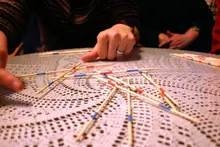
To start, one player holds all the sticks upright in one fist, with the ends resting on the table, and suddenly lets go so they fall in a rough circle. A bad drop can be done again. On your turn you try to take one stick at a time, using your fingers, or by pressing down on a pointed end so that the stick flips up, but no other stick may move even slightly. If you succeed you keep the stick and try another; the moment another stick moves, your turn ends and the stick you were trying stays where it is.
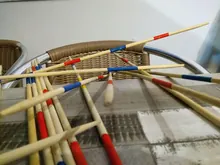
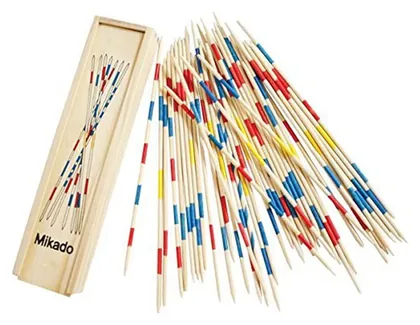
Each stick's colour bands show its points. In the classic European set of 41 sticks there is 1 Mikado worth 20 points (often marked with a spiral or a special band), 5 Mandarins worth 10, 5 Bonzes worth 5, 15 Samurai worth 3 and 15 of the lowest sticks worth 2, for 170 points in all. Smaller 31-stick sets have fewer low-value sticks; a common breakdown is 1 Mikado, 5 Mandarins, 5 Bonzes, 10 Samurai and 10 low sticks, for 145 points. The colours differ from maker to maker, so check the leaflet in your set. Once you have won the Mikado, and in many rules a Mandarin too, you may use it as a tool to lift or flick other sticks, as long as it touches only the stick you are after.
There are two common ways to run a game. In the classic rules, each player gathers the sticks and drops them afresh at the start of their turn, adds up the points of the sticks they picked up, and after 5 rounds the highest total wins. In the simpler family version, everyone plays on one heap until all the sticks have been picked up, and the player with the most points (or, for small children, simply the most sticks) wins. A single heap takes about 5 to 10 minutes, and a 5-round game for three or four players takes roughly 20 to 30 minutes.
Agree on house rules before you start: whether any stick you've won may be used as a tool, and how strict to be about tiny wobbles (the classic rules say even the slightest movement ends your turn). Start with the loose sticks lying on top or off to one side, press down on a pointed tip to lift a stick that lies across others, and rest your elbow on the table to keep your hand steady. Mikado suits anyone with patient fingers, from about 5 years old, and it is one of the few games where children and grandparents play on equal terms.
What's in the box
- 31Wooden pick-up sticks
colour-banded; points per colour, stick length and wood not stated by the brand
From the listing title ('Wooden 31 Pick-Up Sticks', pack of 1) and the brand's own listing on an Indian store ('Mikado Pickup Sticks - 31 Sticks', ages 5-15). Neither mentions a rules leaflet, points chart or container. A 31-stick set often has 1 Mikado, 5 Mandarins, 5 Bonzes, 10 Samurai and 10 low sticks (145 points); the classic European set has 41 sticks (170 points). The same set is also sold in packs of 4 and 8 for return gifts.
Where to buy
A well-made set, on Amazon.in
Many brands make this game. We picked one well-made set; check its size and pieces in the listing before you buy.
Opens Amazon.in in a new tab.
Pick-up sticks sets are made and sold in India by several brands, and imported European Mikado sets cost much more without playing any differently. Our Amazon.in button goes to Trinkets & More's 31-stick wooden set, the only Mikado on the best-seller list. Its maker and country of origin could not be confirmed, so check the box for both, and for the ISI mark if it is for a child.
How to pick a good setWhat to check in the listing before you buy.
- Count the sticks: the classic set has 41 (1 Mikado, 5 Mandarins, 5 Bonzes, 15 Samurai and 15 low sticks), while many cheaper sets have 31. Either plays well, but you need a leaflet or chart that says how many points each band is worth.
- Roll a few sticks on a table: good sticks are straight and all the same length and thickness. Bent or uneven sticks roll, clump and make fair play impossible.
- Run a finger along each stick: it should be sanded smooth with no splinters or rough patches, and the tips should be tapered to a point but not needle-sharp or split.
- Look at the colour bands: they should be crisp, easy to tell apart in ordinary room light, and not flaking. The Mikado stick should stand out clearly from the rest.
- Check the material: hardwood such as beech feels weighty and lies still; bamboo is lighter and fine for children; plastic sticks are slippery and harder to lift by pressing a tip.
- Check the storage: a tube, box or bag that closes properly keeps all the sticks together, and a missing stick changes the scores.
- Mind the points and look for the ISI mark: the sticks are thin and pointed, so supervise children under about 5 and keep sets away from toddlers. Toys for children under 14 sold in India must carry the ISI mark with a BIS licence (CM/L) number.
We link to one well-made set from a maker we could identify; other good sets exist. We don't show prices: Amazon shows today's price, the seller and delivery. Paid link. We may earn a commission, at no extra cost to you.
What reviewers and players say
Mikado is valued as a simple, quiet game of nerve and steady hands that young children can win against adults, and Indian video makers still call it a childhood favourite from the 1990s. The classic rules stress strict play, where even the slightest movement of another stick ends your turn, and that tension is the whole fun. The usual frustrations are arguments over whether a stick really moved, cheap sets with bent or uneven sticks that roll and clump, and leaflets with colour codes that don't match the sticks. Agreeing on house rules before the first drop avoids most disputes.
What people love
- Learned in a minute and played by everyone from five-year-olds to grandparents
- Pure tension: the whole table holds its breath as someone lifts a stick
- A careful child can beat the adults, which few family games allow
- Small, cheap to replace and needs no batteries, just a table
Common complaints
- Arguments over whether another stick moved, so a strict or relaxed rule needs agreeing first
- Poorly made sets with bent, uneven or splintery sticks spoil the game
- Colour codes differ between sets, and without a leaflet nobody knows what each stick is worth
Based on 4 reviews and discussions
- Review Mikado: a timeless game of skill (Judith, Puzzle-Spiele-Welt, June 2024) · ROMBOL blog
- Video MIKADO - HOW TO PLAY || RULES, REVIEW N DEMO (Lets Sit & Play, date not seen) · YouTube
- Reference Mikado rules leaflet (Schmidt Spiele, no date shown) · Schmidt Spiele
- Reference Mikado (game) · Wikipedia
Summarised in our own words from the sources above. We don't use Amazon reviews or ratings.
More like Mikado
Our picks if Mikado isn't quite right
| Feature |
 Mikado
 |
 Jenga
Jenga |
 Topple
 |
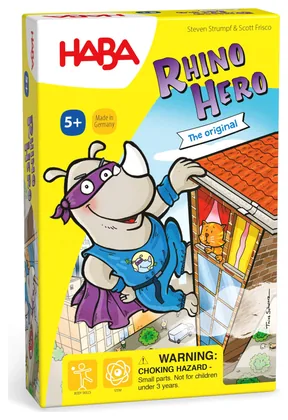 Rhino Hero
 |
|---|---|---|---|---|
| Players | 2–6 | 1–8 | 2–4 | 2–5 |
| Best with | 2-4 | 3-5 | 3-4 | 3-5 |
| Play time | 10–30 min | 5–15 min | 15–30 min | 5–15 min |
| Age | 5+ | 6+ | 6+ | 5+ |
| Rules | Easy | Easy | Easy | Easy |
| Indian edition | – | Yes | Yes | Import |
| Why look at it | This page | The other great steady-hands game, pulling blocks instead of sticks | A balancing game for families that rewards a careful touch | A stacking card game for children who enjoy the wobble-and-hold-your-breath feeling |
More steady-hands games
See allJenga
Pull a block, stack it on top, don't topple the tower
Rhino Hero
Build a wobbly card skyscraper without toppling the rhino
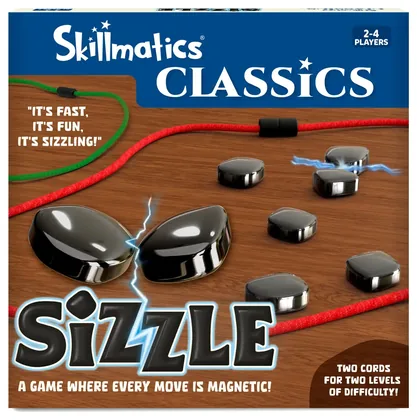
Sizzle
Place magnets inside a loop without letting them snap together.
Topple
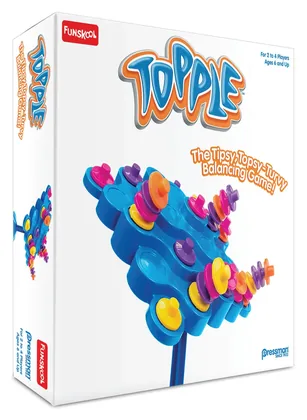
Roll, stack and score on a tower that tips and sways
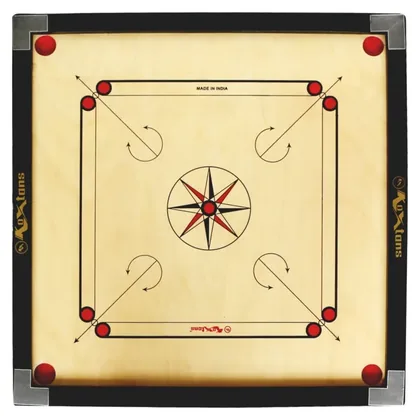
Carrom
Flick the striker, pocket your colour, then capture and cover the queen
Also worth a look (not in our catalogue yet): Kerplunk – Pull sticks out of a tube without letting the marbles drop: Mikado in reverse.
Questions people ask about Mikado
Is Mikado the same as pick-up sticks?
Yes. Mikado is the European version of pick-up sticks, played with longer sticks of equal length marked with colour bands that are worth points. Plain pick-up sticks sets play the same way, but may simply count the sticks you pick up.
How many sticks are there in a Mikado set?
The classic European set has 41 sticks worth 170 points in all. Many sets sold in India have 31 sticks, often with 10 fewer low-value sticks for a total of 145 points; check the leaflet in your set for its colours.
How do you score Mikado?
In the classic set the single Mikado is worth 20 points, each of the 5 Mandarins 10, each of the 5 Bonzes 5, each Samurai 3 and each of the lowest sticks 2. Add up the sticks you picked up; after the agreed number of rounds (traditionally 5), the highest total wins.
Can you use the Mikado stick to pick up other sticks?
Yes. Once you have won the Mikado, you may use it as a tool to lift or flick other sticks, as long as it touches only the stick you are trying to take. Many rules allow a Mandarin as a tool too, and some families let any stick you've won be used.
What age is Mikado suitable for?
Most sets are marked for ages 5 and up, and it stays fun for adults and grandparents. The sticks are thin and pointed, so watch younger children and keep sets away from toddlers.
Game facts
- Publisher
- Trinkets & More
- Players
- 2–6
- Language
- No reading – Nothing to read during play. The only thing to explain is which colour band is worth how many points, and that can be shown with the sticks themselves.
Sources & photo creditsThe references behind this guide.
Facts on this page come from the publisher, the Indian maker or distributor, and the sources below. Photos are credited under each one.
- FirstCry - Trinkets & More Mikado Pickup Sticks - 31 Sticks
- FirstCry - Trinkets & More Mikado Pickup Sticks Pack of 4 - 31 sticks each
- FirstCry - Ratnas Mikado Game Multicolour - 41 Sticks
- Schmidt Spiele - Mikado rules leaflet (German, French, Italian, English, Dutch)
- Djeco - Mikado rules leaflet (DJ05210, 10 languages)
- Mikado (game) - Wikipedia
- Pick-up sticks - Wikipedia
- ROMBOL - Mikado: a timeless game of skill (Judith, Puzzle-Spiele-Welt, June 2024)
- India Briefing - BIS toy certification in India (Toys Quality Control Order)