




Traditional game
Snakes and Ladders
Climb the ladders, dodge the snakes, first to 100 wins
Roll and movePure luckDice rolling
- 2–4best with 2-4
- 15–30 minper game
- Under a minuteto set up
- 4+years
- Very easy
- Nonereading
A well-made set, on Amazon.in
Many brands make this game. We picked one well-made set; check its size and pieces in the listing before you buy.
Paid link. We may earn a commission, at no extra cost to you.
The game in a nutshell
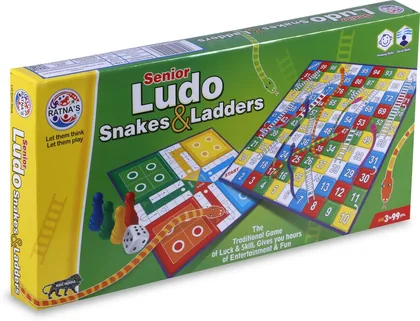
Snakes and Ladders is the first board game most Indian children play: roll the die, climb the ladders, slide down the snakes and race to square 100. It's pure luck, which makes it ideal for children of about 4 to 7 who are learning to count and take turns, and much less fun for older children and adults. It began in India as Gyan Chaupar, or Moksha Patam, a game about virtues and vices. Our link goes to Ratna's Senior 2-in-1 set, with Ludo on the other side of the board.
Is Snakes and Ladders right for you?
Great if
- Children of about 4 to 7 learning to count, read numbers up to 100 and wait their turn
- A first board game where a small child can beat anyone, fair and square
- Telling children the Indian story behind the game, from Moksha Patam to today
- Short games that fit a small child's attention span
Skip it if
- Your children are past about 8; there are no decisions, so they'll soon want Ludo or a game with choices
- You want something the adults will enjoy too; it's luck from the first roll to the last
- Your child takes losing very hard; a long snake near 100 can bring tears (try the cooperative idea below)
How Snakes and Ladders plays
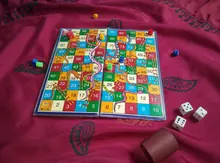
Set-up: everyone puts a counter just off square 1. The board is a 10 by 10 grid numbered 1 to 100, zigzagging up from the bottom row, with ladders and snakes linking squares.
- Time to teach: about 2 minutes.
- Reading and language: Nothing to read except the numbers 1 to 100, which is part of the point for small children. Works in any language.

How to play Snakes and Ladders · Triple S Games
Choose a video · Watch right here
If this creator doesn’t allow embedded playback, watch on YouTube ↗.
Your turn, step by step
- 1Roll
Roll the die and move your counter forward that many squares along the numbered path.
- 2Climb
Land at the foot of a ladder and climb up it; land on a snake's head and slide down to its tail.
- 3Win
The first to reach square 100 wins. Most families need an exact throw to land on it.
The full explanation: how a game of Snakes and Ladders goes
Take turns rolling one die and moving forward that many squares. Land at the foot of a ladder and climb straight up it; land on a snake's head and slide down to its tail. There are no choices to make: the die decides everything.
The first player to reach square 100 wins. Most families play that you must land on 100 exactly. If you throw too much, you either stay put or 'bounce back' by the extra squares: on 98, a five takes you to 100 and back three to 97.
Common house rules: a six gives you another roll, three sixes in a row cancels the turn, and some families make you throw a six to get onto the board, as in Ludo. A game for two to four children usually takes 15 to 30 minutes.
The original Indian game, Gyan Chaupar or Moksha Patam, was a lesson as well as a game: ladders stood for virtues such as generosity and faith, snakes for vices such as anger and theft, and the top of the board was moksha, liberation. For a change with older children, try playing together: everyone must reach 100, and anyone hitting a snake means the whole team starts again.
What's in the box
- 1Playing board
dual-sided: Snakes and Ladders on one side, Ludo on the other - 16Counters
4 each in 4 colours (the Ludo side needs them all), going by an Indian listing for Ratna's Senior Deluxe set - –Die
not listed for this set; one is all the game needs
Box: 37 × 18.5 × 4 cm. Handy to know for gifting and travel.
Ratna's doesn't publish a contents list we could read. The dual-sided board comes from the listing title; the 16 counters come from an Indian marketplace listing for Ratna's 'Ludo with Snakes & Ladders Senior Deluxe' (item 1256), which may be the same set. Snakes and Ladders needs only one counter per player and one die. Check the box for the die before the first game.
Where to buy
A well-made set, on Amazon.in
Many brands make this game. We picked one well-made set; check its size and pieces in the listing before you buy.
Opens Amazon.in in a new tab.
Nobody owns Snakes and Ladders, so choose a well-made set rather than a brand. Our Amazon.in button goes to Ratna's Senior 2-in-1, from a Mumbai toy maker; Indian listings give India as the country of origin for Ratna's sets. Since young children outgrow Snakes and Ladders quickly, a 2-in-1 board with Ludo on the back is better value than a single game.
How to pick a good setWhat to check in the listing before you buy.
- Board: the numbers 1 to 100 should be large and clearly printed, with the path easy to follow, and every snake's head and tail and every ladder's foot and top plainly on a square. Muddy printing causes arguments and confuses small children.
- Material: thick, laminated card survives sticky fingers and wipes clean; wooden or magnetic boards last longer and keep counters in place on journeys.
- Counters and die: chunky counters in clearly different colours, and a die with large, clear dots that small children can count easily.
- Safety: look for the ISI mark and a BIS licence number (CM/L- followed by digits) on the box; under India's Toys (Quality Control) Order it has been required for toys sold in India since 1 January 2021. Counters and dice are small, so keep them away from toddlers.
- Value: a dual-sided board with Ludo on the back, like the set we link, keeps the box in use after children outgrow Snakes and Ladders.
- Storage: a box that closes properly, so the counters and die stay with the board.
We link to one well-made set from a maker we could identify; other good sets exist. We don't show prices: Amazon shows today's price, the seller and delivery. Paid link. We may earn a commission, at no extra cost to you.
What reviewers and players say
Snakes and Ladders is pure luck, and writers who look at it closely say so plainly: no player ever makes a decision, so adults soon get bored, and with several players most children end up losing. That is also its value for small children. They practise counting to 100 and taking turns, and because nobody can be better at it, a four-year-old can beat anyone; one discussion makes the point that a random winner teaches children to win and lose gracefully. Once children are past about 7, move them on to Ludo or a simple cooperative game.
What people love
- Children can play from about 4, as soon as they can count dots on a die
- Good counting and number practice on a 1-100 grid
- Nobody has an advantage, so the youngest can beat a grandparent
- Long ladders and longer snakes make big, funny swings
Common complaints
- There are no choices at all, so adults get bored quickly
- With four players three lose, which can upset small children
- Snakes near the top can drag a game out
Based on 6 reviews and discussions
- Review Snakes and Ladders (kqr, August 2026) · Entropic Thoughts
- Players Snakes and Ladders (discussion thread, 12 comments, August 2026) · Hacker News
- Reference Who invented Snakes and Ladders? (Alexander Krasnobaev, August 2026) · Quantum Game
- Reference Snakes and ladders · Wikipedia
- Reference Gyan chauper · Wikipedia
- Reference How To Play Snakes And Ladders (April 2023) · Bigjigs Toys
Summarised in our own words from the sources above. We don't use Amazon reviews or ratings.
More like Snakes and Ladders
Our picks if Snakes and Ladders isn't quite right
| Feature |
 Snakes and Ladders
 |
 Ludo
Ludo |
 Hoot Owl Hoot!
 |
 Dragomino
 |
|---|---|---|---|---|
| Players | 2–4 | 2–4 | 2–4 | 2–4 |
| Best with | 2-4 | 4 | 2-4 | 2-4 |
| Play time | 15–30 min | 30–60 min | 15 min | 15–20 min |
| Age | 4+ | 5+ | 4+ | 5+ |
| Rules | Easy | Easy | Easy | Easy |
| Indian edition | Yes | Yes | Import | Import |
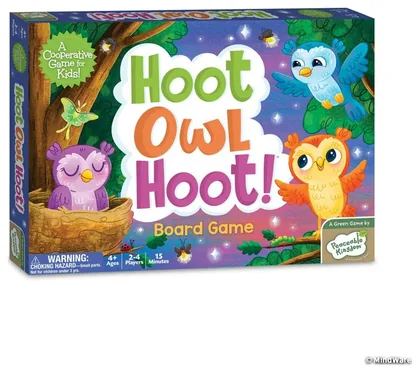
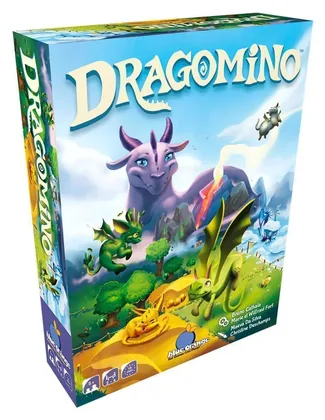
| Why look at it | This page | The next step: the same dice and racing, with a choice of which counter to move | A cooperative race for young children, so nobody loses alone | A first game with real choices for children from about 5 |
More from Ratna's
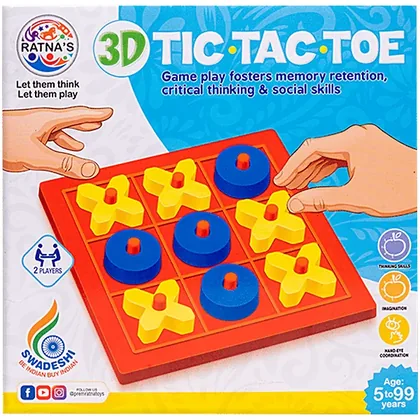
More roll-and-move games
See allLudo
India's favourite race game: roll a six, cut and race home

Business
India's own property game: buy cities, collect rent, build hotels
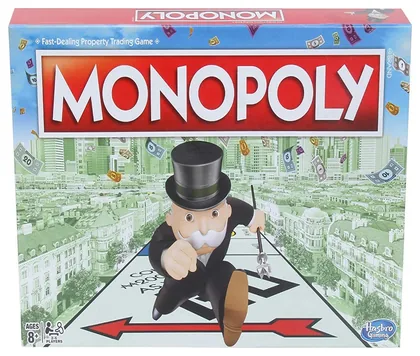
Monopoly
Roll, buy property, collect rent, and bankrupt everyone else

Cluedo
Work out who did it, where, and with which weapon

The Game of Life
Spin through college, jobs, family and retirement; richest player wins
Questions people ask about Snakes and Ladders
Who invented Snakes and Ladders?
No single inventor is known. It grew out of Gyan Chaupar, also called Moksha Patam, an Indian game in which ladders were virtues, snakes were vices and the top square was moksha. The oldest securely dated board is a late-18th-century chart made in Lucknow; the popular story that the 13th-century saint Gyandev (Sant Dnyaneshwar) created it appears only in much later sources. English makers turned it into Snakes and Ladders in the 1890s.
Do you need the exact number to win Snakes and Ladders?
Not in the simplest rules, but most families play that way: you must land exactly on 100. If you throw too much, you either stay put or move up to 100 and bounce back the extra squares. It makes games a few turns longer, so agree on it before you start.
What age is Snakes and Ladders good for?
It suits children from about 4, as soon as they can count the dots on a die, until about 7 or 8, when most want a game with choices. The Ratna's set we link is marked for ages 5 and up. The counters and die are small, so keep them away from toddlers.
Is Snakes and Ladders a game of skill or luck?
Pure luck. Every move is decided by the die, so nobody can get better at it. That is exactly why it's good for young children: a four-year-old can beat a parent, and everyone practises winning and losing gracefully.
What is Saap Seedhi?
Saap Seedhi, or Saanp Seedhi ('snake ladder'), is the Hindi name for Snakes and Ladders. It's the same game, and most Indian sets print the English name on the box.
Game facts
- Publisher
- Ratna's (Prem Ratna Toys, Mumbai)
- In India
- Prem Ratna Toys, Mumbai (maker of Ratna's games)
- Players
- 2–4
- Language
- No reading – Nothing to read except the numbers 1 to 100, which is part of the point for small children. Works in any language.
- Box size and weight
- 37 × 18.5 × 4 cm
Sources & photo creditsThe references behind this guide.
Facts on this page come from the publisher, the Indian maker or distributor, and the sources below. Photos are credited under each one.
- Snakes and ladders - Wikipedia
- Gyan chauper - Wikipedia
- Who invented Snakes and Ladders? (Alexander Krasnobaev, Quantum Game, August 2026)
- Bigjigs Toys - How To Play Snakes And Ladders (April 2023)
- Funskool - Snakes and Ladders (item 4970400)
- Toycra - Ratna's Shut The Box (maker details for Ratna's: Prem Ratna Toys, Mumbai)
- Bureau of Indian Standards - Indian Standards on Toys: ensuring your child's safety (April 2023)