
The children’s board game hub · India
Little players.Big possibilities.
A good children’s game gives them a turn that feels like their own. Find a starting point by age, then look at reading, pace and how much help you’ll need to give.
Find their next game
The short answer
Start with the child. Then the box.
For a first shared win, look at Hoot Owl Hoot! For matching without a speed race, consider Dragomino. For a child who wants to build something with their hands, try Rhino Hero. Older children can move into planning with First Journey or Kingdomino.
“Can we be on one team?”
Cooperative choices for a shared goal.
“I want to do it myself.”
Pictures, matching and short turns.
“Let me make a plan.”
A next step for more confident players.
The boardgames.in shortlist
Small hands. Their own big decisions.
Filter the shortlist, then compare what the child does with what an adult helps with. Ages below are box guidance, not a promise of fit.
Show games whose box starting age fits your child. Younger-age games can still be fun for older children.
Showing all 7 games.
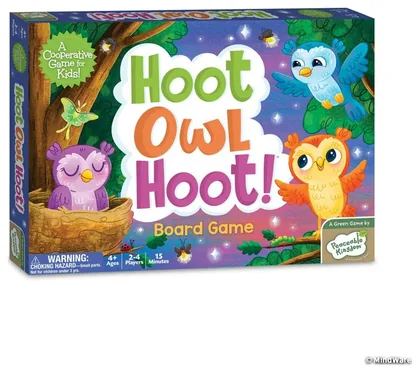
Move the owls home before sunrise. We would start here when a child wants to help the group rather than compete for an individual win.
- Child’s part
- Match colours and choose which owl to move.
- Adult’s part
- Teach the colour and sun cards, set up and support turn-taking.
Reading: No reading during play.
Colour matching is central. Everyone can lose together; cooperative does not mean a guaranteed happy ending.
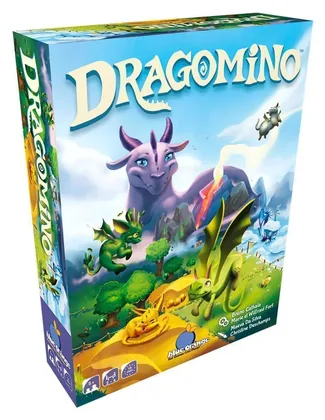
Connect landscapes and uncover dragon eggs. This is our direction for a child who likes matching and collecting but does not enjoy a race to shout first.
- Child’s part
- Match landscape edges and choose a place for a tile.
- Adult’s part
- Explain the matching rule and help count at the end.
Reading: No text to read on tiles or eggs.
It is competitive, and the egg reveals introduce chance. Adults should let the child choose a tile rather than optimise every move.
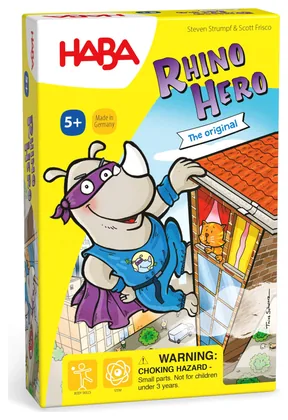
Add cards to a growing tower and move the tiny superhero upwards. Choose this for someone more excited by making a structure than studying a board.
- Child’s part
- Place wall and roof cards carefully.
- Adult’s part
- Set up a stable surface and explain the roof symbols.
Reading: Roof symbols, not written instructions.
A wobbly surface or a bump can spoil the tower. Collapses are part of the game and may be frustrating for some children.
Check the edition
This is the original Rhino Hero, not Super Battle. Check your box for its player guidance; publisher listings differ.

Gather clues and work out which suspect stole the pie. We would choose it for children who enjoy talking through a shared mystery.
- Child’s part
- Compare clues with suspects and discuss who to rule out.
- Adult’s part
- Teach the clue decoder and help keep the investigation moving.
Reading: Picture clues; an adult teaches the rules.
An adult can easily solve things aloud before the children get a chance. Give them time to notice and explain the clues.
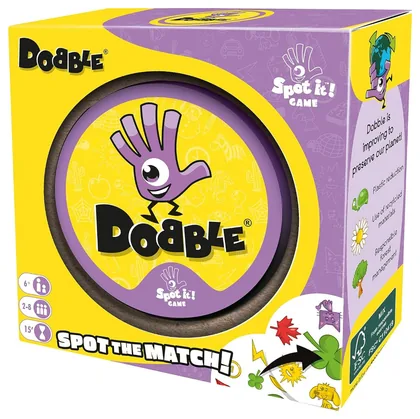
Find the picture shared by two cards. This makes sense for a child who actively enjoys quick reactions and wants a game that starts with a simple visual task.
- Child’s part
- Recognise a shared symbol and respond quickly.
- Adult’s part
- Agree on picture names and teach one mini-game at a time.
Reading: Picture matching; name the symbols in a shared language.
Speed differences matter. It may not suit a younger sibling playing against very fast older children.
Check the edition
Standard Dobble is the recommendation here. Dobble Kids and themed editions can have different ages and contents.
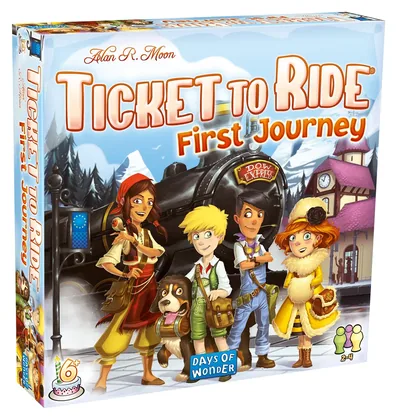
Collect train cards and connect the places on your tickets. Consider this when a child is ready to hold a simple goal in mind across several turns.
- Child’s part
- Match train colours and connect ticket destinations.
- Adult’s part
- Show how to find places on the map and check completed tickets.
Reading: Landmark pictures help; city names may need adult support.
It is a junior game, not the standard Ticket to Ride. Check whether the box has the Europe or USA map.
Check the edition
Our catalogue covers First Journey: Europe. The publisher also makes a USA version.
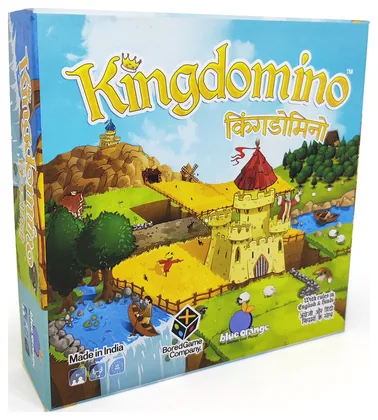
Build a small kingdom from landscape tiles. We would consider it for an older child who likes arranging shapes and can weigh today’s tile against tomorrow’s choice.
- Child’s part
- Choose tiles, match terrain and think about space.
- Adult’s part
- Explain the picking order and help with scoring if needed.
Reading: No reading on landscape tiles.
Counting and multiplication are part of scoring. Helping calculate is different from deciding where every tile goes.
No matches in this shortlist.
Try “Any style” or reset the filters. We would rather show fewer choices than recommend a game above the selected age.
Player counts, starting ages and times refer to the editions in our catalogue; timings are not first-session estimates. Fit and watch-out notes are our editorial judgement. Product photographs and source credits are on each game page.
A little know-how
Age is the start of the conversation.
Ages 4–5: a turn they can own
Begin with one clear task and an adult nearby. Matching, placing and taking turns can be enough; a long list of “learning benefits” is not needed.
Ages 6–7: check the reading
A child may understand a clever game before they can comfortably read its cards. Look at the components, not only the rulebook language.
Ages 8+: follow their interests
More birthdays do not automatically mean more appetite for complexity. A visual puzzle may delight a confident reader who simply dislikes word games.
With siblings, compare confidence as well as age.
Fast games can magnify differences in reactions. If one child routinely takes every match, choose a game with individual turns or a shared goal instead. That is often more satisfying than asking the quicker player to pretend not to see the answer.
In a cooperative game, invite each child to explain their idea before an adult suggests a move. Helping with reading or arithmetic need not mean taking over the decision.
A little help should open the game up.
Learn the setup before inviting children to the table. Show one normal turn, and let them handle the pieces as you explain. On a first play, choose a time when no one is already tired or rushed. Publisher timings are useful for comparison, not a deadline for a learning session.
“No reading during play” does not mean “no adult needed”. Someone still needs to understand the rules, explain the symbols and support a child who gets stuck. Follow the age and safety information on the particular box, especially around younger siblings and small pieces.
Choosing a children’s game in India.
Check the exact edition and language before buying. An English rulebook may be easy for an adult to explain in Hindi or another shared language, but a word-heavy game asks more of each player. Pictures and colour matching bring their own needs too; inspect the components if colour recognition is a concern.
The game pages below each recommendation collect edition details and the Amazon.in buying route. This shortlist is based on fit, not a claim that every game is currently in stock or equally easy to obtain.
Before you roll
A few good questions.
Which board games can a five-year-old play?
Dragomino, Rhino Hero and Outfoxed! have five-plus guidance in our catalogue. Hoot Owl Hoot! starts at four-plus. Choose among matching, building or cooperative play according to the child, and confirm the guidance on the actual box.
What are good board games for six-year-olds?
Dobble is an option for a child who enjoys racing to spot a picture. First Journey offers planning with adult help. Dragomino, Rhino Hero and Outfoxed! can still be relevant: an earlier starting age does not make a game unsuitable at six.
Are these educational games?
They involve activities such as matching, counting, planning and discussion. We do not treat those activities as proof of educational or developmental outcomes. Enjoyment and a meaningful part in the game are our first selection criteria.
Does the age filter recommend every game below my child’s age?
It only removes games whose catalogue starting age is higher than the age you select. It is not an assessment of your child or a ranking. Read the ability, adult-help and watch-out notes to make the final choice.
Behind the shortlist
A little homework. A clearer choice.
Researched on 14 October 2026 using publisher pages, official rules and our edition-specific catalogue. Recommendations are editorial judgements, not claims of hands-on testing. We considered the decisions a player makes, reading demands, group size and the reasons a game may not fit. Inclusion does not imply current availability in India.
Open the source shelf
- Peaceable Kingdom · Hoot Owl Hoot! ↗
- Blue Orange · Dragomino rules ↗
- HABA · Rhino Hero ↗
- Gamewright · Outfoxed! ↗
- Zygomatic · Dobble ↗
- Days of Wonder · First Journey ↗
- Blue Orange · Kingdomino rules ↗
Our game pages link further edition evidence. Where editions differ, use the actual box and rulebook as the final reference.