
Family game
Qwirkle
Match colours or shapes to build lines of six tiles
Tile layingPattern buildingPure strategy
- 2–4best with 2-4
- 30–45 minper game
- About 2 minto set up
- 6+years
- Easy
- Nonereading
The official edition, on Amazon.in
There's no Indian edition, so this is the official imported game. Amazon shows today's price, the seller and delivery.
Paid link. We may earn a commission, at no extra cost to you.
The game in a nutshell
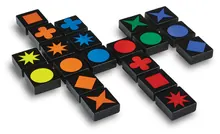
Qwirkle is a tile-laying family game for 2 to 4 players aged 6 and up: you build rows and columns of chunky tiles that share either a colour or a shape, and score for every line you add to. It won Germany's Spiel des Jahres (Game of the Year) in 2011 and takes 30 to 45 minutes. It suits families with young children, grandparents and anyone who likes Scrabble-style tile play without the spelling.
Is Qwirkle right for you?
Great if
- Families with children from about six: there is nothing to read, and the rules fit on a single sheet
- Grandparents, parents and children at one table, since simple matching sits alongside real planning
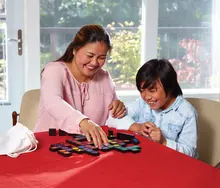
- A quiet game for two after dinner, as well as a family of four during the school holidays
- People who enjoy Scrabble or dominoes but want a game with no words
Skip it if
- You usually have more than four players; the game stops at four
- You want a theme or a story; Qwirkle is an abstract game of colours and shapes
- Your group gets restless while someone works out their best-scoring move
A place on the honours list
Good company to be in.
Recognition from beyond our table.
Spiel des Jahres (German Game of the Year), 2011 (Winner)
How Qwirkle plays
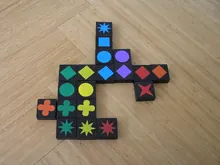
Put all 108 tiles in the bag and draw six each, placing them in your tile rack so no one else can see them. There is no board: the tiles build their own grid on the table. Whoever holds the most tiles that share one colour or one shape starts by laying those tiles in a line.
- Time to teach: about 5 minutes.
- Reading and language: The tiles carry only colours and shapes, so there is nothing to read during play and everyone can talk in Hindi, Tamil or any language at the table. The rules sheet is in English (MindWare's printed rules also include Spanish). Keeping score needs simple addition.

Official How to play Qwirkle · MindWare · Official
Choose a video · Watch right here
If this creator doesn’t allow embedded playback, watch on YouTube ↗.
Your turn, step by step
- 1Place
Add one or more tiles to a single line on the table; they must all share one colour or one shape, with no repeats in the line.
- 2Score
Score a point for every tile in each line you made or extended; completing a line of six is a Qwirkle and earns 6 bonus points.
- 3Draw
Refill your rack to six tiles, or swap tiles with the bag instead of playing if you're stuck.
- 4Win
When the bag is empty, the first player out of tiles ends the game and gets 6 bonus points; highest total wins.
The full explanation: how a game of Qwirkle goes
On your turn you either add tiles or swap them. The tiles you add must go into a single line, and they must share one colour or one shape. Every line on the table has to stay a matching set with no repeats: all six shapes in red, say, or one shape in all six colours, but never two red circles. Then draw back up to six. If you can't play, or don't like your tiles, swap some or all of them with the bag instead and score nothing that turn.
You score one point for every tile in each line you create or add to, counting the tiles already there, so a tile that joins two lines scores both of them. Finishing a line of all six is a Qwirkle and earns 6 bonus points, so that line is worth 12.
Once the bag is empty, nobody draws any more. The first player to use up all their tiles ends the game and gets 6 bonus points, and the highest total wins.
Watch what you leave open: a line of five invites the next player to make a Qwirkle. Reviewers note that grabbing the biggest score every turn isn't always best, and that a little defence pays off over a game.
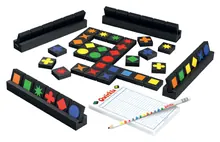
What's in the box
- 108Tiles
three of each of 36 combinations: six colours (red, orange, yellow, green, blue, purple) and six shapes (circle, square, diamond, clover, four-point star, eight-point star) - 4Tile racks ('trays')
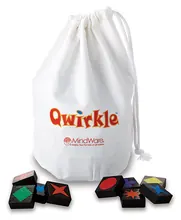
wooden, one per player, to keep your six tiles organised and out of sight - 1Storage bag
for drawing tiles and storing them - 1Score pad or score card
- 1Pencil
- 1Rules sheet
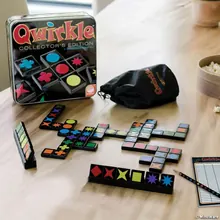
MindWare sells two boxes that match the linked 'Deluxe with Trays' listing, and both contain the items above: the Collector's Edition (108 acrylic tiles, 4 wooden racks, nylon bag, score card, pencil, rules) and the standard game with the Tile Racks & Scorepad pack (108 wooden tiles, canvas bag, 4 wooden racks, score pad, pencil, rules). The tiles in the linked box may be wood or acrylic. MindWare's standard box on its own has just the 108 wooden tiles, a canvas bag and rules, with no racks.
Where to buy
The official edition, on Amazon.in
There's no Indian edition, so this is the official imported game. Amazon shows today's price, the seller and delivery.
Opens Amazon.in in a new tab.
There is no Indian edition of Qwirkle and no Indian distributor was found, so copies sold here are MindWare's American boxes, imported; MindWare's Canadian distributor lists the standard game as made in China. Our Amazon.in link goes to MindWare's Qwirkle with tile racks ('trays'): the same 108-tile game, plus a wooden rack for each player to keep their six tiles organised and hidden.
How to make sure you get a genuine copyA little care before you click.
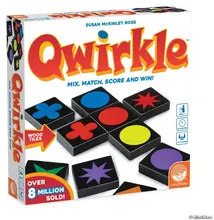
- The box carries the Qwirkle name and the MindWare logo, and credits Susan McKinley Ross as the designer
- There are exactly 108 tiles: three of each of 36 combinations of six colours (red, orange, yellow, green, blue, purple) and six shapes (circle, square, diamond, clover, four-point star, eight-point star)
- The listing names MindWare and says the box comes with tile racks or trays
- The rules sheet explains the 6-point Qwirkle bonus for a line of six and the 6-point bonus for going out first
We link to one Amazon.in listing that we've checked against the maker's own information. We don't show prices: Amazon shows today's price, the seller and delivery. Paid link. We may earn a commission, at no extra cost to you.
What reviewers and players say
Reviewers see Qwirkle as a family game that gets a lot out of very few rules: match a colour or a shape, score your lines, and watch the grid spread across the table. They like that small children can play it from the first turn while adults still find real choices, such as scoring two lines with one tile and not leaving an easy Qwirkle for the next player. The standard game's chunky, colourful tiles get frequent praise, and the Spiel des Jahres jury singled out how quickly new players get absorbed. The common caveats are that it is abstract, with no theme, that tile draws can leave one player behind with little chance to catch up, and that careful players can slow the game down.
What people love
- Rules explained in under five minutes, so mixed-age groups and young children can join in
- Chunky, brightly coloured tiles that are pleasant to handle
- Simple rules that still hide real decisions, such as scoring two lines at once and not setting up the next player
- Quick to bring out again and again as a regular family game
Common complaints
- It is abstract, with no theme or story, which leaves some players cold
- Random tile draws can decide a game, and a player who falls behind may not catch up
- Turns can drag while players work out the best-scoring spot
Based on 5 reviews and discussions
- Review SdJ Re-Reviews #33: Qwirkle (Chris Wray, with comments from other writers, December 2015) · The Opinionated Gamers
- Review Qwirkle – what's a Qwirkle? (Trent, January 2010) · The Board Game Family
- Review Qwirkle Board Game Review (Ronny Alexander, December 2025) · Co-op Board Games
- Award Qwirkle – Spiel des Jahres 2011 (Spiel des Jahres jury, read 14 October 2026) · Spiel des Jahres
- Reference Qwirkle (Wikipedia, read 14 October 2026) · Wikipedia
Summarised in our own words from the sources above. We don't use Amazon reviews or ratings.
More like Qwirkle
Our picks if Qwirkle isn't quite right
| Feature |
 Qwirkle
 |
 Scrabble
 |
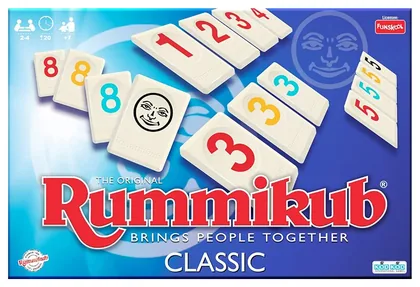 Rummikub
 |
 Blokus
 |
|---|---|---|---|---|
| Players | 2–4 | 2–4 | 2–4 | 2–4 |
| Best with | 2-4 | 2-3 | 3-4 | 4 |
| Play time | 30–45 min | 50–60 min | 20–60 min | 20–30 min |
| Age | 6+ | 10+ | 7+ | 7+ |
| Rules | Easy | Medium | Easy | Easy |
| Indian edition | Import | Import | Yes | Yes |
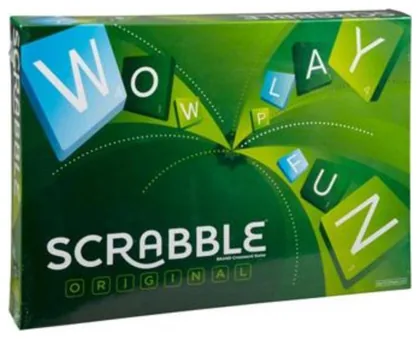
| Why look at it | This page | The classic tile-laying game; Qwirkle builds a similar criss-cross grid with colours and shapes instead of words | Another family tile game about making runs and sets from your own hidden tiles | A colourful abstract game that families with young children pick up in minutes |
More by Susan McKinley Ross
More tile-laying games
See all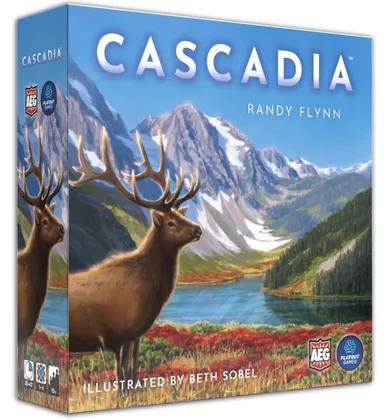
Cascadia
Build a Pacific Northwest landscape and fill it with wildlife

Carcassonne
Build a medieval map tile by tile, then claim it
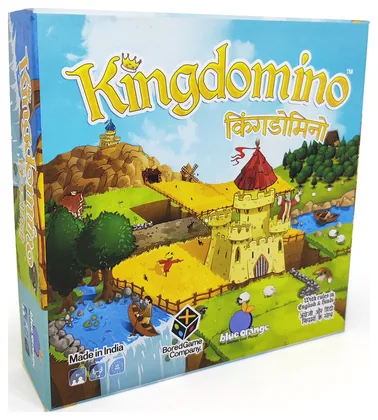
Kingdomino
Build a tiny kingdom from land dominoes in twenty minutes
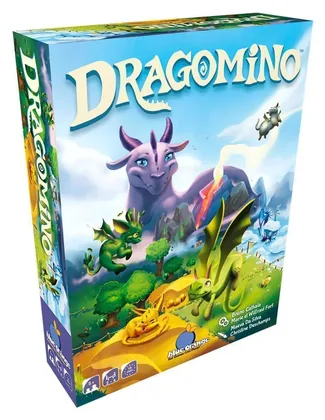
Dragomino
Kingdomino for five-year-olds: match landscapes, hatch baby dragons

Labyrinth
Shift the maze walls to reach your treasures first
Questions people ask about Qwirkle
Is Qwirkle available in India?
Yes, as an imported game. There is no Indian edition, so copies sold here are MindWare's American boxes. Our Buy on Amazon.in button goes to MindWare's Qwirkle with tile racks, which is the full 108-tile game plus a rack for each player.
What age is Qwirkle suitable for?
MindWare says 6 and up, and reviewers say young children pick it up quickly because it is all about matching colours and shapes. It works just as well for adults and grandparents, which makes it a good pick for mixed-age family evenings.
Do you need the tile racks to play Qwirkle?
No. The standard game has no racks; players simply keep their six tiles hidden in front of them. Racks make it easier to see your own tiles and keep them out of sight, which younger players in particular find helpful.
What is the difference between Qwirkle and Travel Qwirkle?
Travel Qwirkle has the same 108 tiles and rules, but the wooden tiles are much smaller (about 2 cm) and come in a pouch, so it suits train journeys and holidays. The full-size game is easier for small hands and older eyes.
How many players can play Qwirkle?
Two to four. It plays well with two, and with four you get more competition for the best spots on the table, along with a little more waiting between turns.
Game facts
- Designed by
- Susan McKinley Ross
- Publisher
- MindWare
- First published
- 2006
- Players
- 2–4
- Language
- No reading – The tiles carry only colours and shapes, so there is nothing to read during play and everyone can talk in Hindi, Tamil or any language at the table. The rules sheet is in English (MindWare's printed rules also include Spanish). Keeping score needs simple addition.
- Awards
- Spiel des Jahres (German Game of the Year), 2011 (Winner)
Sources & photo creditsThe references behind this guide.
Facts on this page come from the publisher, the Indian maker or distributor, and the sources below. Photos are credited under each one.
- MindWare – Qwirkle Tile Matching Game (item 32016)
- MindWare – Qwirkle Deluxe Collector's Edition
- MindWare – Qwirkle Tile Racks & Scorepad Bonus Pack
- MindWare – Travel Qwirkle
- Outset Media – Qwirkle, MW-32016 (UPC, size, weight, country of origin)
- Outset Media – Qwirkle Collector's Edition
- Spiel des Jahres – Qwirkle (2011 winner)
- Qwirkle rules (MindWare, English and Spanish)
- Qwirkle game rules – UltraBoardGames
- Qwirkle – Wikipedia
- Board Games India – Qwirkle