
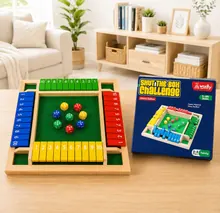


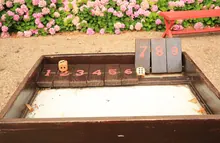
Traditional game
Shut the Box
Roll two dice, flip down the tiles, leave the smallest total
- 1–4best with 2-4
- 5–20 minper game
- Under a minuteto set up
- 6+years
- Very easy
- Nonereading
A well-made set, on Amazon.in
Many brands make this game. We picked one well-made set; check its size and pieces in the listing before you buy.
Paid link. We may earn a commission, at no extra cost to you.
The game in a nutshell
Shut the Box is a wooden dice-and-tiles game: you roll two dice, flip down tiles that add up to the roll, and try to leave the smallest total, or close every tile to 'shut the box'. It takes two minutes to learn, gives children lots of quick addition practice, and works for one to four players. The set we link is Wudly's four-sided box, which lets up to four people play at once.
Is Shut the Box right for you?
Great if
- Children of about 6 to 10 practising addition: every roll is a small sum, and splitting a 9 into 4 + 5 or 2 + 3 + 4 builds number sense
- Quick rounds at family get-togethers, with grandparents and grandchildren around the same box
- Playing alone: it works as a solo patience game when nobody else is free
- A good-looking wooden gift that needs no reading
Skip it if
- You want real strategy: the dice decide most of the game
- You want a long game: rounds take a few minutes and play out much the same way each time
- You need quiet: dice rattling on wood are loud unless the tray is lined with felt
How Shut the Box plays
Flip all the tiles up so the numbers show: 1 to 9 on a classic box, 1 to 10 on each side of Wudly's. With a classic single box, players take turns and reset the tiles for the next person. With a four-sided box like Wudly's, each player sits at one side, has their own row of tiles, and takes the two dice of their colour.
- Time to teach: about 2 minutes.
- Reading and language: Only the numbers on the tiles and the dots on the dice. Nothing to read, so it works in any language.

How to play Shut the Box · Triple S Games
Choose a video · Watch right here
If this creator doesn’t allow embedded playback, watch on YouTube ↗.
Your turn, step by step
- 1Roll
Roll both dice and add them up. Once your 7, 8 and 9 are closed, you may roll just one die.
- 2Flip
Flip down any open tiles that add up to your roll, such as 9, or 4 and 5, or 2, 3 and 4. Keep rolling until you can't make the total.
- 3Score
Add up the tiles left open: the lowest score wins. Close every tile and you've shut the box, which wins at once.
The full explanation: how a game of Shut the Box goes
Roll both dice and add them up, then flip down any open tiles that make that total. A roll of 9 could close the 9 on its own, or 1 and 8, 2 and 7, 4 and 5, or even 2, 3 and 4. Keep rolling and closing tiles. Once the 7, 8 and 9 are all down, you may roll just one die; some families play that you switch to one die once the open tiles add up to 6 or less. Your turn ends when you roll a total you can't make from the open tiles.
Add up the tiles still open: that's your score, and the lowest score wins the round. Close every tile and you have 'shut the box', which wins at once. Some rules read the open tiles as a number instead, so a 2 and a 7 left open score 27. Over several rounds, keep a running total; a common house rule puts out anyone who reaches 45.
In a four-sided box, everyone rolls at the same time and works on their own side. When you can't go any more, call out 'done' and wait for the others. University Games' rules for its four-way box play until someone has won 10 rounds.
Alone, it becomes a patience game: just try to shut the box. Even with perfect play you'll manage it only about one time in ten. A common tip: when you have a choice, close one big tile (the 9) rather than two small ones (4 and 5), and save the small tiles for later, when you may be rolling only one die. And remember that 7 is the most common total with two dice.
What's in the box
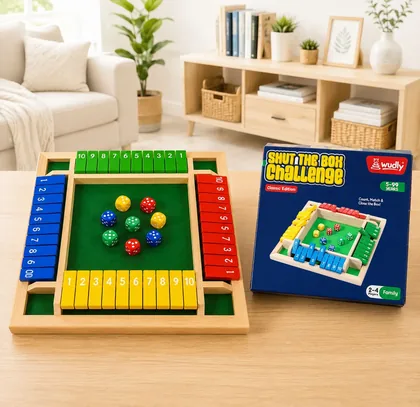
- 1Four-sided wooden board
about 22 cm square and 3 cm thick, with a row of ten flip tiles numbered 1 to 10 on each side, one colour per player - 8Dice
wooden dice, two in each player's colour
From Wudly's own product picture ('What's inside'): one wooden board, 22 x 22 cm and 3 cm thick, and 8 wooden dice. Whether a rules sheet is included isn't stated. A classic single box has one row of tiles numbered 1 to 9 and 2 dice.
Where to buy
A well-made set, on Amazon.in
Many brands make this game. We picked one well-made set; check its size and pieces in the listing before you buy.
Opens Amazon.in in a new tab.
Shut the Box has no official edition, so any well-made wooden set will do. The link goes to the four-player box from Wudly, a toy brand based in Ahmedabad; its own store gives India as the country but doesn't say outright where the box is made. Imported sets from makers such as University Games (US) or Jaques of London (UK) cost much more and play the same game.
How to pick a good setWhat to check in the listing before you buy.
- Pick the shape first: a classic 1-to-9 box (one player at a time, 2 dice) or a four-sided box (2 to 4 players at once, 8 dice in four colours). Four-sided boards range from about 22 cm square (Wudly's) to about 36 cm, so check the size.
- Wood: look for solid wood with tight corners, a sanded finish and no splinters. Wudly says 'premium-quality wood with smooth edges' but doesn't name the wood.
- Tiles: each tile should flip with a light push and stay where you leave it, up or down, without flopping back when dice hit it or someone bumps the table.
- Dice: a classic box needs two, and a four-sided box needs eight, a pair per player in that side's colour. Full-size dice with clear dots are easiest for children; keep a spare pair, because dice go missing.
- Felt: a felt-lined rolling tray keeps the noise down and stops dice bouncing out. Bare wood is much louder.
- Tile numbers: 1 to 9 is standard, and the rules on this page assume it. Boxes with 10 or 12 tiles (Wudly's and Clapjoy's have 10) make the box harder to shut and games longer.
- Safety mark: toys sold in India must carry the ISI mark with a BIS licence number on the toy or its box, under the Toys (Quality Control) Order in force since January 2021. Neither Wudly's store nor the listing title mentions it, so check the box when it arrives.
We link to one well-made set from a maker we could identify; other good sets exist. We don't show prices: Amazon shows today's price, the seller and delivery. Paid link. We may earn a commission, at no extra cost to you.
What reviewers and players say
Shut the Box is liked as a simple classic that slips a lot of mental arithmetic into play. Maths teachers and educational writers use it for addition and number bonds, and rules sites list many house variants, from 12-tile boxes to knock-out rules at 45 points. It's mostly luck, so it works as a quick family game or a warm-up rather than a strategy game, and each player mostly plays alone. Maths fans enjoy the odds: with perfect play you shut the box only about one time in ten.
What people love
- It's very quick to learn: roll, add, flip
- There's plenty of mental maths: teachers use it for addition and number bonds, and NRICH lists it for ages 5 to 7
- It works as a solo challenge as well as a group game
- There are lots of house rules to keep it fresh: 10- or 12-tile boxes, knock-out at 45, team play
Common complaints
- It's mostly luck: your choices matter a little, the dice matter more
- There's little interaction, because each player works through their own tiles
- Shutting the box is rare, about one game in ten even with perfect play, so it's 'harder to do than you might think'
Based on 6 reviews and discussions
- Reference Shut the Box (NRICH, University of Cambridge, date not shown) · NRICH
- Review Teach Key Numeracy Skills with Shut the Box (Joe Jaques, date not shown) · Jaques of London
- Reference Analysis of Shut the Box (Bill Butler, date not shown) · Durango Bill
- Review Shut the Box rules and variants (Gather Together Games, date not shown) · Gather Together Games
- Reference Shut the box (Wikipedia, read October 2026) · Wikipedia
- Video How to Play: SHUT THE BOX - The Classic Pub Dice Game (Play-In Games, date not checked) · YouTube
Summarised in our own words from the sources above. We don't use Amazon reviews or ratings.
More like Shut the Box
Our picks if Shut the Box isn't quite right
| Feature |
 Shut the Box
 |
 Ludo
Ludo |
 Super Math Spy
 |
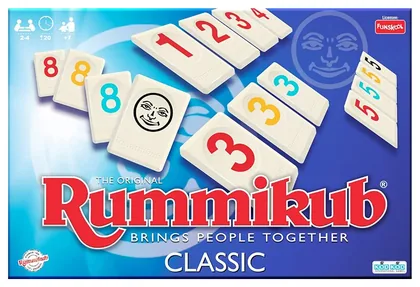 Rummikub
 |
|---|---|---|---|---|
| Players | 1–4 | 2–4 | 2–4 | 2–4 |
| Best with | 2-4 | 4 | 2-4 | 3-4 |
| Play time | 5–20 min | 30–60 min | 15–20 min | 20–60 min |
| Age | 6+ | 5+ | 7+ | 7+ |
| Rules | Easy | Easy | Easy | Easy |
| Indian edition | – | Yes | Yes | Yes |
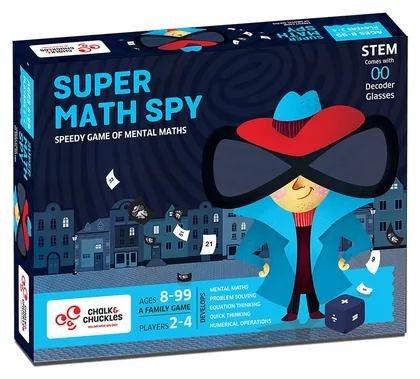
| Why look at it | This page | India's favourite dice game, for the same family crowd | More number practice: race to build an equation that hits a target | Number tiles again, with far more strategy |
More dice games
See allLudo
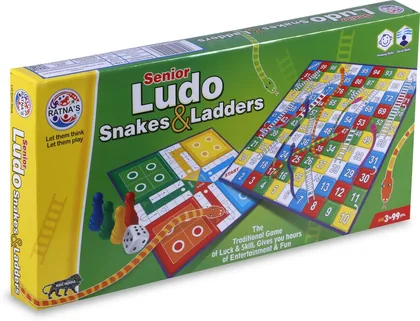
India's favourite race game: roll a six, cut and race home
Snakes and Ladders
Climb the ladders, dodge the snakes, first to 100 wins

King of Tokyo
Roll dice as a giant monster and fight to rule Tokyo.

Topple
Roll, stack and score on a tower that tips and sways
Catan
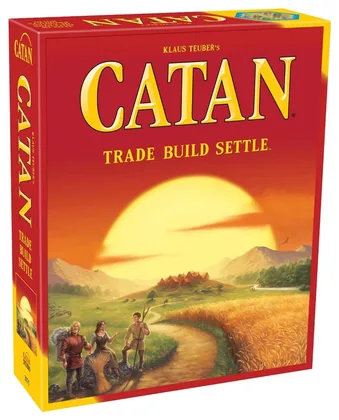
Trade wheat for brick, build roads, and race to ten points.
Also worth a look (not in our catalogue yet): Yahtzee – Another dice classic: roll five dice and score combinations.
Questions people ask about Shut the Box
When can you roll only one die in Shut the Box?
The most common rule says you may switch to one die once the 7, 8 and 9 are all closed, because two dice can never roll a 1 and a single die gives you a better chance of hitting the small numbers left. Some families switch once the open tiles add up to 6 or less. Either is fine; just agree before you start.
Is Shut the Box good for learning maths?
Yes. Every roll is an addition sum, and children learn that the same total can be made in several ways: 9 is 9, 1 + 8, 4 + 5 or 2 + 3 + 4. The University of Cambridge's NRICH maths site lists it for ages 5 to 7 under mental calculation. Older children can work out why 7 comes up most often with two dice.
What is the difference between the four-player box and the classic box?
A classic box has one row of tiles numbered 1 to 9 and two dice, and players take turns. A four-sided box has a row of tiles on each side and a pair of dice for each player, so up to four people play at once and nobody waits. The rules are the same.
Where does Shut the Box come from?
Nobody knows for sure. It's usually described as an old European pub dice game, and stories link it to Normandy in France centuries ago and to sailors, fishermen and fur trappers, but there's no solid record. What is documented is that it was played in English pubs by the 1960s, said to have come from the Channel Islands, and that it was the basis of the American TV game show High Rollers from 1974.
How often can you actually shut the box?
Not often. One mathematical analysis found that with perfect choices you shut all nine tiles about 9.8% of the time if you switch to one die when 6 or less is left, and about 7.1% if you always roll two dice. So expect to manage it roughly once in every ten or so games.
Game facts
- Publisher
- Wudly (Wudly Toys, Ahmedabad)
- In India
- Wudly Toys (Ahmedabad, Gujarat)
- Players
- 1–4
- Language
- No reading – Only the numbers on the tiles and the dots on the dice. Nothing to read, so it works in any language.
Sources & photo creditsThe references behind this guide.
Facts on this page come from the publisher, the Indian maker or distributor, and the sources below. Photos are credited under each one.
- Wudly Toys - Wudly Wooden Shut the Box Math & Family Board Game with Color Dice (maker's store)
- Shut the box - Wikipedia
- University Games - Shut the Box 4-Way Play
- Analysis of Shut the Box (Durango Bill)
- NRICH (University of Cambridge) - Shut the Box
- Gather Together Games - Shut the Box rules
- Jaques of London - Teach key numeracy skills with Shut the Box
- Dice Game Shut the Box (activity sheet, Dufferin County Museum and Archives site)
- Intertek - India Toy (Quality Control) Order 2020 approved (November 2020)
- Clapjoy - Slingo & Shut the Box combo